A spring with a spring constant of 40 N/m is stretched by 0.20 m. How much elastic potential energy is stored?
Based on: AQA spec 4.1.1.2
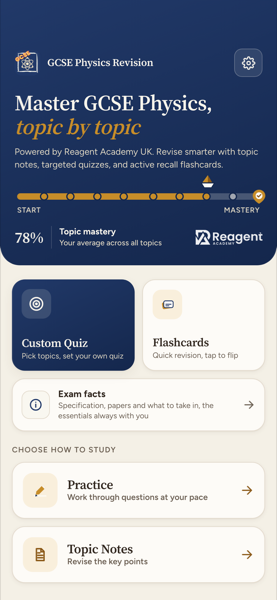
Revise for AQA GCSE Physics (specification 8463, Higher tier), topic by topic. 655 original questions across two tiers, recall and application, 308 flashcards, and a one-page topic note for each of the eight topics. There is also a ninth bank devoted to the equations: what every symbol means, the unit of each quantity, how to rearrange, and how to convert units before you substitute. Build a custom quiz from any mix of topics. Every question is written to the public AQA subject content, never copied from a real exam paper, with a plain-English explanation on every answer. Made in collaboration with Reagent Academy.
GCSE Physics with AQA (specification 8463) is the separate-science Physics GCSE, sat by most students at the Higher tier. It is assessed by two written exam papers covering eight topics, and there is no coursework. This app is built for the Higher tier and covers the whole specification, both papers, including the physics-only content that Combined Science students do not sit.
There are two papers. Paper 1 and Paper 2 are each 1 hour 45 minutes long and worth 100 marks, so the GCSE is 200 marks in total. Each paper mixes multiple-choice, structured, closed short answer and open response questions.
The eight topics are split across the two papers. Paper 1 covers the first four topics and Paper 2 covers the last four. This app organises its questions and flashcards by exactly these topics, and adds a ninth category for the equations.
You need a ruler and a scientific calculator for both papers, and a protractor as well for Paper 2. AQA supplies the Physics Equations Sheet with the paper as an insert. The sheet does not remove the work: you still have to know what each symbol means, which equation fits the situation in front of you, and how to rearrange it and convert the units before you substitute. That is exactly what this app's equations bank drills.
GCSE science is tiered. Higher-tier papers target grades 4 to 9 and include the harder material and the more demanding calculation and maths questions; Foundation tier targets grades 1 to 5. This app is written for Higher-tier students, so the questions and the calculations match that level.
Every question is original and written to the publicly available AQA GCSE Physics subject content (specification 8463). No AQA exam papers, mark schemes or textbook text is copied. Because Physics is calculation-heavy, every number in the pack is recomputed during review: each question is checked by a second, independent AI model from a different family before it ships, and qualified GCSE teachers from Reagent Academy review the questions after launch. The free sample questions below let you judge the quality before you buy.
Not in this version, and the questions are written so that none are needed. Where a question would normally lean on a circuit diagram or a graph, the setup is described in words instead, for example the values of two resistors in series or the readings on a velocity-time graph. Diagrams are planned for a later release, reviewed by our teaching partner before they ship.
The app is built by RiverMap Learning in collaboration with Reagent Academy, a UK GCSE tuition provider. RiverMap writes the original questions to the public AQA specification and builds the app; Reagent Academy's GCSE teachers help review the questions for accuracy and specification alignment, and recommend the app to their students.
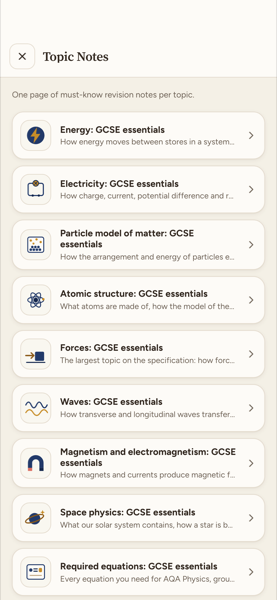
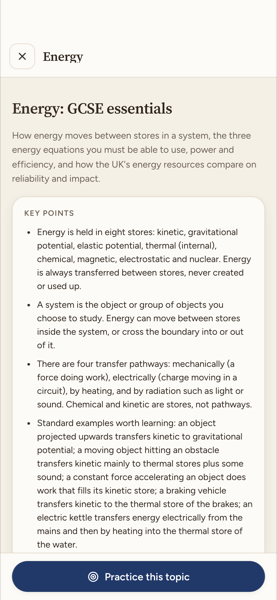
Revise each of the eight topics from a one-page note: the must-know points, every equation the topic needs with its units, the key terms the exam rewards, and the common mistakes to avoid.
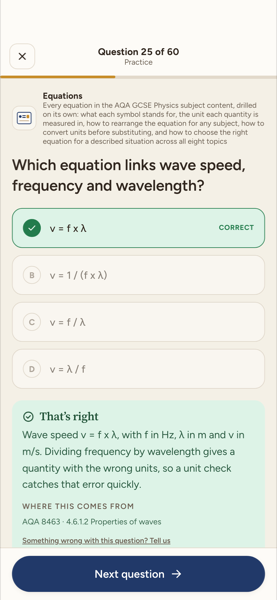
A whole category on the equations themselves. Name the equation that links a set of quantities, give the unit of each symbol, rearrange for any subject, convert grams to kilograms or cm3 to m3 before you substitute, and spot the error in a worked answer.
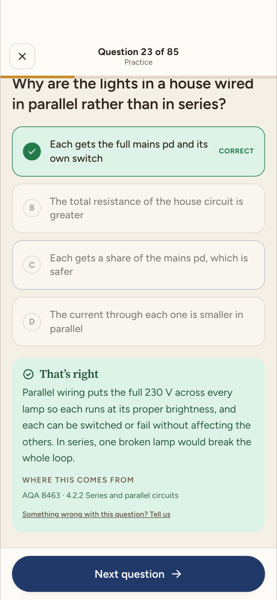
Work through every question by topic, each tagged recall or application, with a plain-English explanation on every answer, so you learn why an answer is right rather than just which letter it was.
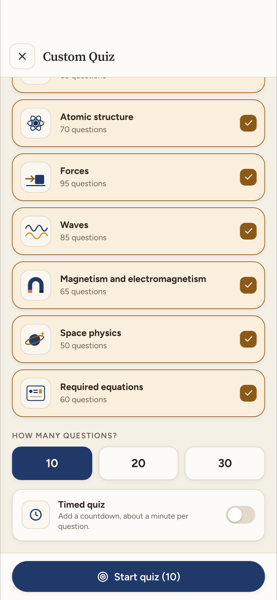
Mix any topics into your own quiz, choose the length, and get a score with a per-topic breakdown. There is no pass mark, just useful revision that shows you what to review next.
Drill definitions, equations and key facts, from specific heat capacity and Fleming's left hand rule to half-life and red-shift, with a deeper tier for exam-level recall.
| Based on the official public source | Yes, AQA GCSE Physics specification (8463), Higher tier subject content |
|---|---|
| Timed mock exam | 72 questions, 80 min |
| Pass rule applied | 69% to pass |
| Answer explanations mapped to the source | Yes |
| Weak-area review | Yes |
| Flashcards (spaced repetition) | Yes |
| Works fully offline, no account | Yes |
| Ads | None |
| Payment | One-time purchase |
| Last content review | 2026-07-26 |
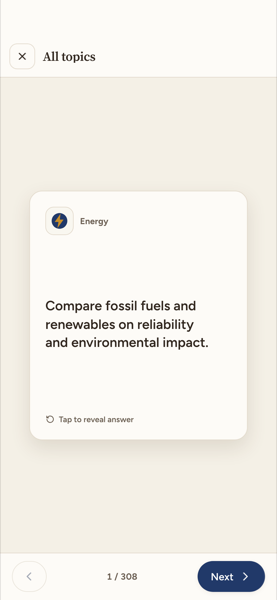
Tap an answer to see why it is right, mapped to the official source, exactly as in the app.
A spring with a spring constant of 40 N/m is stretched by 0.20 m. How much elastic potential energy is stored?
Based on: AQA spec 4.1.1.2
A 20 Ω resistor carries a current of 3.0 A. What power is dissipated in it?
Based on: AQA spec 4.2.4.1
A 2.5 kW immersion heater warms 5.0 kg of water for 3.0 minutes. Assuming no energy is lost, what is the temperature rise? The specific heat capacity of water is 4200 J/kg°C.
Based on: AQA spec 4.3.2.2
The count-rate from a sample falls from 3200 counts per second to 200 counts per second in 60 hours. What is the half-life?
Based on: AQA spec 4.4.2.3
A car of mass 1000 kg travelling at 20 m/s brakes to rest in a distance of 40 m. Assuming all of its kinetic energy is transferred by the braking force, what is the average braking force?
Based on: AQA spec 4.5.6.3
A ship sends a sound pulse straight down and detects the echo from the sea bed 0.40 s later. Sound travels at 1500 m/s in sea water. How deep is the sea bed?
Based on: AQA spec 4.6.1.5
A transformer has 200 turns on its primary coil and 5000 turns on its secondary coil. The primary is supplied with 12 V. What is the secondary potential difference?
Based on: AQA spec 4.7.3.4
A hydrogen line is measured at 656 nm in the laboratory, but the same line in the light from a galaxy arrives at 700 nm. What does this show?
Based on: AQA spec 4.8.2
The force on a current-carrying conductor in a magnetic field is F = B x I x L. Which rearrangement gives the magnetic flux density?
Based on: AQA spec 4.7.2.2
A sound wave has a frequency of 250 Hz. Using T = 1 / f, what is its period in standard form?
Based on: AQA spec 4.6.1.2
Prefer to start in your browser? Work free, topic-by-topic practice questions and use our free calculators, no download needed, then unlock the full bank in the app.
Built from AQA GCSE Physics specification (8463), Higher tier subject content (AQA specification 8463, for 2026 exams), the official public source, used under The AQA specification is referenced only to align topic coverage. All questions are 100% original; no AQA exam papers, mark schemes or textbook text is reproduced. Scientific facts and equations are not copyrightable.. View the official source .
Last checked against the source: 2026-07-26.
All questions are original and written from the public source. No official exam questions are copied.
No. This is an independent study aid. It is not affiliated with, endorsed by, or sponsored by AQA. It is written to align with the publicly available AQA GCSE Physics specification (8463), but the questions are our own.
The whole GCSE. It covers all eight topics across both Paper 1 (Energy, Electricity, Particle model of matter, Atomic structure) and Paper 2 (Forces, Waves, Magnetism and electromagnetism, Space physics), at Higher tier, including the physics-only content.
No, and that is deliberate. Every question is original and written to the public AQA subject content. We do not copy AQA past papers or mark schemes, both for copyright reasons and so you practise the ideas rather than memorising one paper. Every question is written against a specific point of the published subject content, and every answer has its own plain-English explanation.
Yes, that is one of the reasons it exists. Alongside the eight topics there is a ninth bank devoted to the equations: naming the equation that links a set of quantities, the unit of every symbol, rearranging for any subject, converting units before substituting, and spotting the error in a worked substitution. AQA supplies an equations sheet in the exam, and none of that work goes away when you have it.
Not in this version. The questions are written so no diagram is needed: circuits, graphs and force arrangements are described in words instead. Diagrams are planned for a later release and will be reviewed by our teaching partner before they ship.
Higher tier. The questions, the calculations and the maths are pitched at the Higher tier, which targets grades 4 to 9. Combined Science (Trilogy) students sitting Higher Physics will find most of the content relevant, although Combined Science does not include Space physics or the other physics-only material.
Yes. Everything is stored on your device, so you can revise without an internet connection and there is no login or account to create.
Use the restore purchase option in the app. The one-time purchase is tied to your app store account, so you can restore it on any device using the same account.
Each question is generated and then independently checked by a second AI model from a different family, which recomputes every calculation, confirms the keyed answer is correct and confirms the distractors are wrong, with a human resolving anything flagged. Qualified GCSE teachers from Reagent Academy also review the questions after launch. You can read the full process at rivermaplearning.com/how-we-build-questions.
The app is built by RiverMap Learning in collaboration with Reagent Academy, a UK GCSE tuition provider (reagentacademyuk.com). RiverMap writes the original questions and builds the app; Reagent Academy's GCSE teachers help review the questions and recommend it to their students.
Free, in-depth answers written from the same official sources the app is built on.
AQA GCSE Physics (8463) is two 1h 45m papers worth 100 marks each. There is no fixed pass mark: grade boundaries are set after every exam series.
AQA GCSE Physics (8463) is two 1h 45m papers worth 100 marks each across eight topics. AQA supplies the equations sheet, which changes how to revise.
One purchase. Every question. Yours offline, forever.
This app is not affiliated with, endorsed by, or sponsored by AQA or any exam board. It is an independent study aid. Every question is original and written to the publicly available AQA GCSE Physics subject content (specification 8463, Higher tier, Papers 1 and 2); no AQA exam papers, mark schemes, or other copyrighted material are reproduced. GCSE grades are set by annual grade boundaries, not a fixed pass mark, so the readiness target shown in this app is an unofficial practice guide only. Always check the current specification and your exam timetable with AQA and your school.