
What score is required to pass the Pennsylvania notary public examination?
Based on: commission_appointment
Over 1,000 study items written from the actual law (the Revised Uniform Law on Notarial Acts and the Pennsylvania Code), with every question cited to the exact statutory passage it comes from.
Pennsylvania requires every new notary applicant, and anyone whose commission has lapsed even by a day, to pass a computer-based examination administered by Pearson VUE for the Department of State. The exam is based on the state's basic education course of study: the statutes, regulations, procedures and ethics relevant to notarial acts, including electronic notarization.
The exam has 30 multiple-choice questions: 25 scored items plus 5 unscored pretest items mixed in. You have 60 minutes once you accept the non-disclosure agreement.
You need a scaled score of 75 or higher, set by 4 Pa. Code § 167.15(d). Pennsylvania does not publish a raw number-correct pass mark; questions are weighted and the score is scaled, so treat any specific "X out of 25" figure you see elsewhere as unofficial. Our mock exams use an unofficial 80% practice target, which is deliberately stricter than most estimates of the real bar.
Each attempt costs $65, paid to the testing vendor. After the department approves your application you get a 6-month window in which you may test as many times as needed, but no more than once per 24-hour period. If you cannot pass within the window, you must retake the basic education course and reapply.
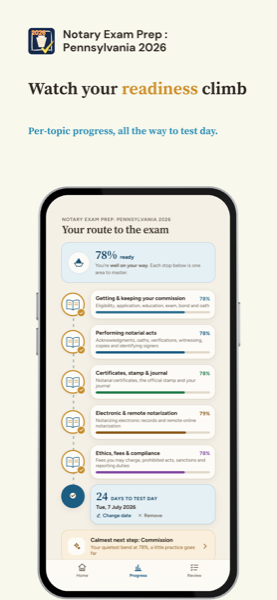
The official content outline weights the 25 scored items across three domains: Obtaining Notary Commission (4 items), Performing Notarial Acts, whether paper-based, electronic or remote (18 items), and Notary Commission Management and Compliance (3 items). All of it flows from two sources: the Revised Uniform Law on Notarial Acts (57 Pa.C.S. Chapter 3) and the Department of State's notary regulations (4 Pa. Code Part VIII Subpart C): commissioning and bonds, the five core notarial acts, identification rules, certificates and short forms, the official stamp, journal-keeping, electronic and remote notarization, fees, prohibited acts and sanctions. This app's five study categories cover the same ground, and its mocks mirror the official domain weighting.
540 original questions across the five real content areas (commissioning, notarial acts, certificates & journal, electronic & remote notarization, and ethics & fees), every one citing the statute or regulation it comes from.
Full 30-question, 60-minute sittings weighted to the official Pearson VUE content outline (Obtaining Notary Commission, Performing Notarial Acts, and Commission Management & Compliance), drawn fresh from the bank each time with a strict practice pass target.
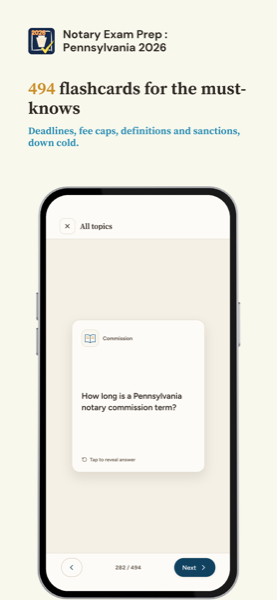
Every deadline, fee cap, definition and sanction ground as a quick-fire card: the $42 application fee, the $25,000 bond, the 45-day recording rule, the 10-year recording retention and hundreds more.
| Based on the official public source | Yes, Revised Uniform Law on Notarial Acts (RULONA), 57 Pa.C.S. Chapter 3, and 4 Pa. Code Part VIII Subpart C (Notaries Public) |
|---|---|
| Timed mock exam | 30 questions, 60 min |
| Pass rule applied | 80% to pass |
| Answer explanations mapped to the source | Yes |
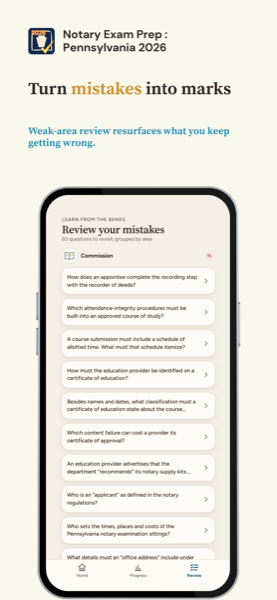
| Weak-area review | Yes |
| Flashcards (spaced repetition) | Yes |
| Works fully offline, no account | Yes |
| Ads | None |
| Payment | One-time purchase |
| Last content review | 2026-06-17 |
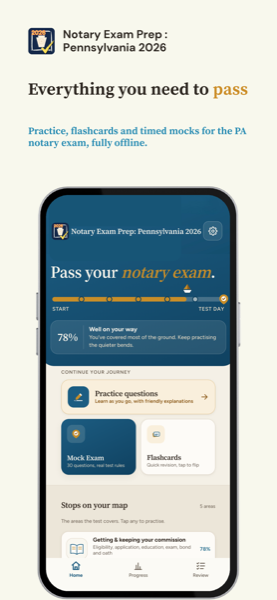
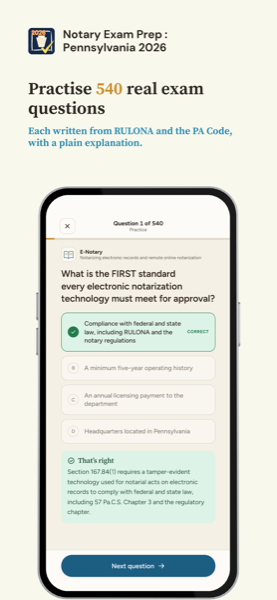
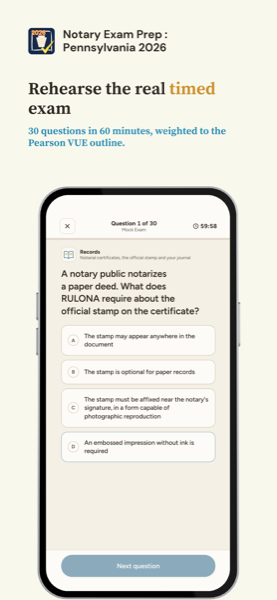
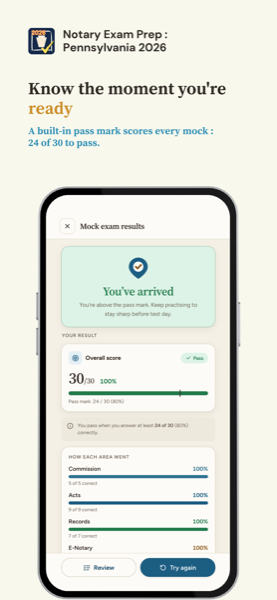
Tap an answer to see why it is right, mapped to the official source, exactly as in the app.
What score is required to pass the Pennsylvania notary public examination?
Based on: commission_appointment
What is the maximum fee a Pennsylvania notary may charge for taking an acknowledgment with one name on the certificate?
Based on: ethics_compliance
How long must the audio-visual recording of a remote notarization be retained?
Based on: electronic_remote
Which set best matches the statutory list of notarial acts a Pennsylvania notary may perform?
Based on: notarial_acts
When someone makes an acknowledgment before a notary, what are they declaring?
Based on: notarial_acts
How must every Pennsylvania notarial act be evidenced?
Based on: certificates_stamp_journal
When a notary notarizes a paper deed, what does the law require of the official stamp on the certificate?
Based on: certificates_stamp_journal
What is the minimum age to apply for a Pennsylvania notary public commission?
Based on: commission_appointment
When a notarization is performed remotely, where must the notary be located?
Based on: electronic_remote
Which actions may the Department of State take against a notary's commission for misconduct?
Based on: ethics_compliance
Prefer to start in your browser? Work free, topic-by-topic practice questions and use our free calculators, no download needed, then unlock the full bank in the app.
Built from Revised Uniform Law on Notarial Acts (RULONA), 57 Pa.C.S. Chapter 3, and 4 Pa. Code Part VIII Subpart C (Notaries Public) (Current Pennsylvania statutes and administrative code, 2026), the official public source, used under Public domain (statute and regulation text; government edicts doctrine), with express Commonwealth consent to reproduce regulation text under 1 Pa. Code § 3.44. View the official source .
Last checked against the source: 2026-06-17.
All questions are original and written from the public source. No official exam questions are copied.
30 multiple-choice questions (25 scored plus 5 unscored pretest items) with a 60-minute time limit, administered by Pearson VUE.
A scaled score of 75, set by 4 Pa. Code § 167.15(d). Pennsylvania does not publish a raw number-correct pass mark, so percentage figures you see elsewhere are unofficial.
$65 per attempt. You may retake it as often as needed within your 6-month authorization window, but not more than once in any 24-hour period.
You can keep retesting within your 6-month window at $65 per attempt. If the window closes without a pass, you must retake the 3-hour basic education course and submit a new application.
Yes. All 540 questions and 494 flashcards are stored on your device. No account, no login, and no internet connection needed after download.
No. This is an independent study aid built from the public text of the law (57 Pa.C.S. Chapter 3 and the Pennsylvania Code). It is not affiliated with or endorsed by the Pennsylvania Department of State, and the practice pass mark it uses is an unofficial study target.
Every question is written from the official public materials for this exam and cites the source passage it comes from. Before it ships, a second, independent AI model from a different family confirms that the cited passage supports the answer, and a human reviews anything the two models disagree on. You can read the full process at rivermaplearning.com/how-we-build-questions, and the free sample questions above let you judge the quality before you buy.
No. It is an independent study tool, not affiliated with or endorsed by the Pennsylvania Department of State. It is built from publicly available official materials (the Revised Uniform Law on Notarial Acts at 57 Pa.C.S. Chapter 3 and the Pennsylvania Code); the questions are original, and we never copy the real exam's own questions.
No study tool can promise that. Our practice mock mirrors the official format and pass mark where the authority publishes one, and clearly labels any practice length or pass mark that is our own rehearsal format rather than an official figure. Use the app alongside the official study materials, not instead of them.
Free, in-depth answers written from the same official sources the app is built on.
The Pennsylvania notary exam trips candidates on a handful of recurring issues. Learn the five most common mistakes and how to avoid them before your first attempt.
Direct answers to the most-asked questions about the Pennsylvania notary public exam: who must take it, how many questions, the pass mark, costs, retakes, and eligibility.
Step-by-step study plan for the Pennsylvania notary exam: 30 questions, 60 minutes, scaled score of 75 to pass. Learn which topics carry the most weight and how to practise effectively.
The Pennsylvania notary exam is 30 questions in 60 minutes. You need a scaled score of 75. Here is a breakdown of the format, scoring, topics, and retake rules.
One purchase. Every question. Yours offline, forever.
This app is not affiliated with or endorsed by the Pennsylvania Department of State or the Commonwealth of Pennsylvania. It is an independent study aid based on the publicly available text of the Revised Uniform Law on Notarial Acts (57 Pa.C.S. Chapter 3) and the Pennsylvania Code (4 Pa. Code Part VIII Subpart C). The pass mark used in practice mocks is an unofficial study target: the real Pennsylvania notary examination is reported only as a scaled score, with 75 required to pass.