What is the primary characteristic that makes someone a private investigator under the Act?
Based on: interpretation_scope
An offline practice app for Ontario's private investigator licensing test, built straight from the law the exam tests: the Private Security and Investigative Services Act, 2005 and its Code of Conduct, the privacy statutes (PIPEDA, FIPPA and MFIPPA), and the Criminal Code's arrest and use-of-force provisions. Drill every rule, then sit timed mock exams.
To be licensed as a private investigator in Ontario you must pass the ministry's private investigator test. It is a written, multiple-choice exam, and most of it tests your knowledge of the law that governs private investigators: the Private Security and Investigative Services Act, 2005 (PSISA) and its Code of Conduct, privacy law, and the relevant parts of the Criminal Code.
The test has 60 multiple-choice questions and you are given 75 minutes to complete it, within a two-hour appointment.
The official cut score is 77%. (Some third-party sites quote a lower figure such as 62%, but the ministry's pass mark is 77%.)
This app covers the legal, privacy and criminal-law core of the Ontario PI exam (the parts of the syllabus that come from published, openly-licensed law), with hundreds of cited questions and flashcards across:
It covers the law and regulations the exam tests: the PSISA and Code of Conduct, privacy law, and the Criminal Code arrest and use-of-force rules. The official syllabus also includes practical-skills topics (investigative technique, report writing, ethics, communication and self-management) that are taught in your mandatory training course rather than drawn from legislation; study those from your course materials.
Tests are booked in advance, online or by phone, through Serco DES Inc., the ministry's test delivery agent. You need a Training Completion Number (TCN) from your approved training to book. The fee is CA$35.00 plus 13% HST, for a total of CA$39.55 per attempt, and results are made available within five business days.
Work through hundreds of questions by category: the PSISA and Code of Conduct, privacy law (PIPEDA, FIPPA, MFIPPA) and Criminal Code arrest powers, each with a plain-English explanation and the section it comes from.
Sit a timed 60-question mock under real conditions: 75 minutes, 77% to pass, just like the ministry test, so you know you are ready before you book.
Hundreds of quick-recall cards for the facts the test loves: definitions, licence types, time limits, penalty amounts, the Code of Conduct duties, the privacy principles, and the rules for arrest and use of force.
| Based on the official public source | Yes, Private Security and Investigative Services Act, 2005 and O. Reg. 363/07, with PIPEDA, FIPPA, MFIPPA and the Criminal Code arrest and use-of-force provisions |
|---|---|
| Timed mock exam | 60 questions, 75 min |
| Pass rule applied | 77% to pass |
| Answer explanations mapped to the source | Yes |
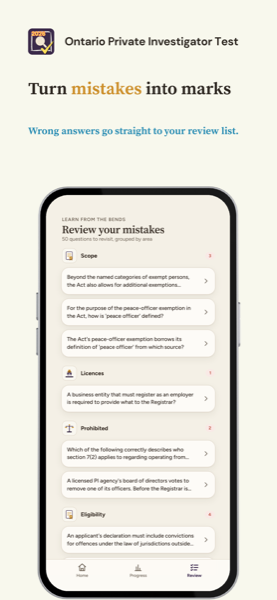
| Weak-area review | Yes |
| Flashcards (spaced repetition) | Yes |
| Works fully offline, no account | Yes |
| Ads | None |
| Payment | One-time purchase |
| Last content review | 2026-06-17 |
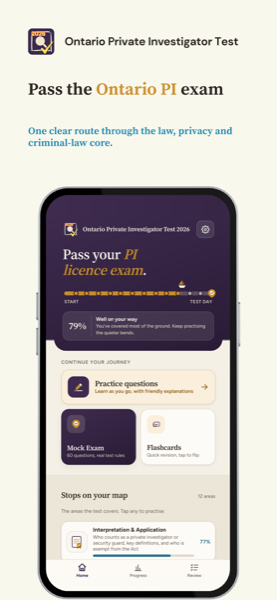
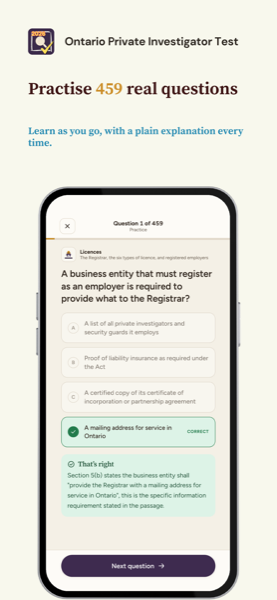
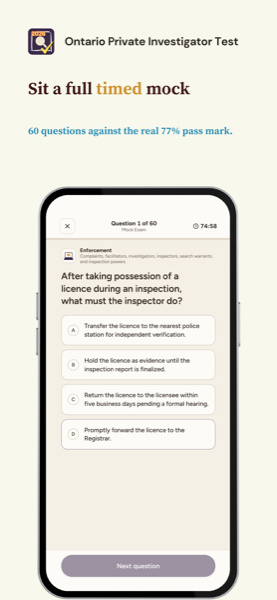
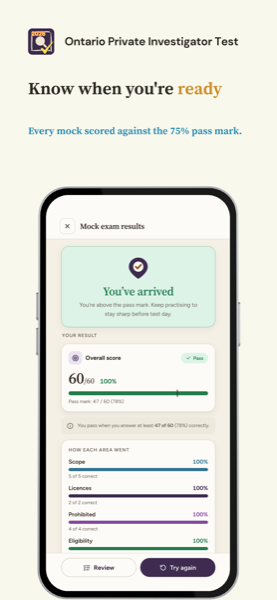
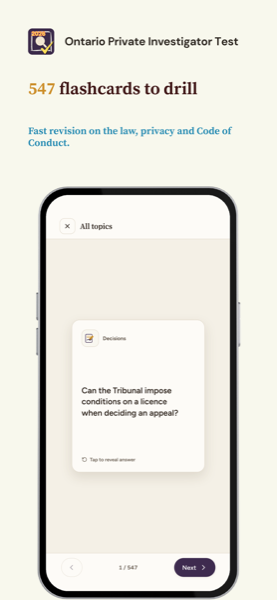
Tap an answer to see why it is right, mapped to the official source, exactly as in the app.
What is the primary characteristic that makes someone a private investigator under the Act?
Based on: interpretation_scope
What is the maximum fine an individual can face on conviction for an offence under the Act?
Based on: offences_penalties
Under PIPEDA, what does "personal information" mean?
Based on: privacy_pipeda
How many distinct types of licence may be issued under the Act?
Based on: administration_licences
Can a licensee transfer their licence to another person or business?
Based on: licensing_requirements
At what times may an inspector enter premises to carry out an inspection?
Based on: complaints_investigations
Which of these terms is NOT prohibited for a licensee to use under section 40?
Based on: duties_standards
How many duties does the Code of Conduct expressly impose on every individual licensee while working?
Based on: code_of_conduct
FIPPA governs provincial institutions. Which institutions does MFIPPA govern?
Based on: privacy_public_records
Under Criminal Code section 35, what standard decides whether an act done in defence of property is justified?
Based on: criminal_arrest_force
Prefer to start in your browser? Work free, topic-by-topic practice questions and use our free calculators, no download needed, then unlock the full bank in the app.
Built from Private Security and Investigative Services Act, 2005 and O. Reg. 363/07, with PIPEDA, FIPPA, MFIPPA and the Criminal Code arrest and use-of-force provisions (Current statutes (PSISA and O. Reg. 363/07)), the official public source, used under Ontario statutes reproduced under the King's Printer for Ontario terms; federal statutes under the Reproduction of Federal Law Order (both permit accurate, unofficial reproduction, including commercial use). View the official source .
Last checked against the source: 2026-06-17.
All questions are original and written from the public source. No official exam questions are copied.
Yes. It is a written exam of 60 multiple-choice questions, completed in 75 minutes within a two-hour appointment.
77%. Some third-party sites quote a lower number such as 62%, but the ministry's official cut score is 77%.
Mostly the law: the Private Security and Investigative Services Act, 2005 and its Code of Conduct, privacy law (PIPEDA, FIPPA and MFIPPA), and the Criminal Code's arrest and use-of-force rules. It also covers practical-skills topics from your training course, such as investigative technique and report writing.
The fee is CA$35.00 plus 13% HST, for a total of CA$39.55 per attempt. You book through Serco, the ministry's test delivery agent, after completing your training and receiving a Training Completion Number (TCN).
Yes. The app is fully offline with no account or login, and it is unlocked with a single one-time in-app purchase. There is nothing to subscribe to.
No. This is an independent study aid. It is not affiliated with or endorsed by the Government of Ontario or the Government of Canada. It is based on the publicly available text of the PSISA and O. Reg. 363/07, PIPEDA, FIPPA, MFIPPA and the Criminal Code.
Every question is written from the official public materials for this exam and cites the source passage it comes from. Before it ships, a second, independent AI model from a different family confirms that the cited passage supports the answer, and a human reviews anything the two models disagree on. You can read the full process at rivermaplearning.com/how-we-build-questions, and the free sample questions above let you judge the quality before you buy.
No. It is an independent study tool, not affiliated with or endorsed by the Government of Ontario or the Government of Canada. It is built from publicly available official materials (the Private Security and Investigative Services Act, 2005, O. Reg. 363/07, and the privacy and criminal law it tests); the questions are original, and we never copy the real exam's own questions.
No study tool can promise that. Our practice mock mirrors the official format and pass mark where the authority publishes one, and clearly labels any practice length or pass mark that is our own rehearsal format rather than an official figure. Use the app alongside the official study materials, not instead of them.
Free, in-depth answers written from the same official sources the app is built on.
To hold an Ontario private investigator licence you must be 18+, have a clean criminal record, be entitled to work in Canada, and pass the ministry test. Full requirements explained.
A step-by-step study plan for the Ontario PI test: 60 questions, 77% to pass, covering the PSISA, privacy law and Criminal Code. Here is how to prepare.
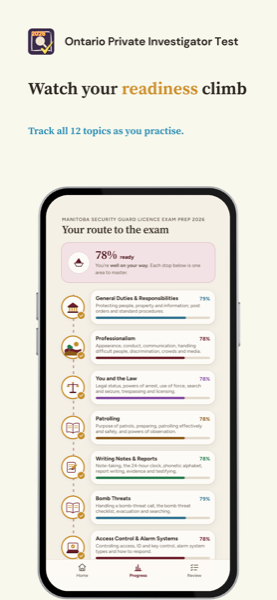
The Ontario PI licensing test is 60 questions in 75 minutes. The pass mark is 77%. Here is the full topic breakdown across all 12 areas and how scoring works.
The Ontario private investigator licence requires approved training and a 77% pass mark on a 60-question test. Here is everything you need to know before applying.
One purchase. Every question. Yours offline, forever.
This app is not affiliated with, authorized by, or endorsed by the Government of Ontario, the Government of Canada, the Ministry of the Solicitor General, the Office of the Privacy Commissioner of Canada, or the Registrar under the Private Security and Investigative Services Act, 2005. It is an independent study aid based on publicly available Ontario and federal legislation. Ontario legislative text is reproduced unofficially from the Private Security and Investigative Services Act, 2005, O. Reg. 363/07, FIPPA and MFIPPA (© King's Printer for Ontario, 2026); federal text from PIPEDA and the Criminal Code is reproduced unofficially under the Reproduction of Federal Law Order.