What does Part 171 establish Federal standards for?
Based on: 40 CFR 171.1 (Scope)
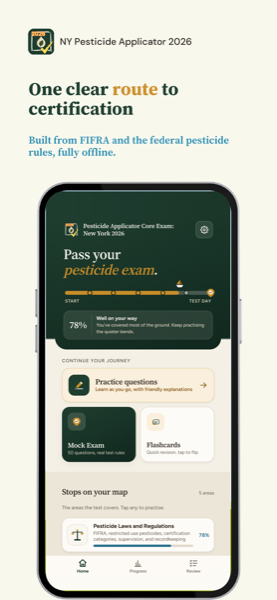
Get ready for the New York pesticide applicator core certification exam with a large bank of practice questions and flashcards. Every item is built from public United States pesticide law and federal regulations, so what you study is what the exam tests.
The core exam is the first step toward becoming a certified commercial pesticide applicator in New York. It is administered by the New York State Department of Environmental Conservation and is based on the core training material and the pesticide laws and regulations that apply to every applicator, no matter which category they go on to work in.
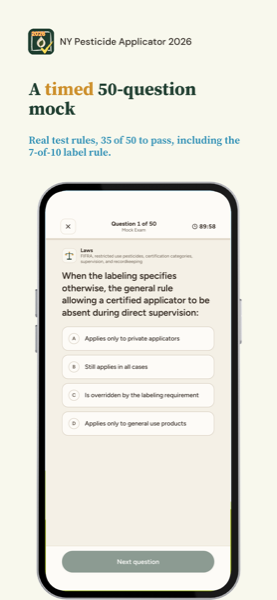
The core exam has 50 multiple-choice questions and a time limit of 90 minutes. It is a closed-book exam, so you cannot bring the manual or notes.
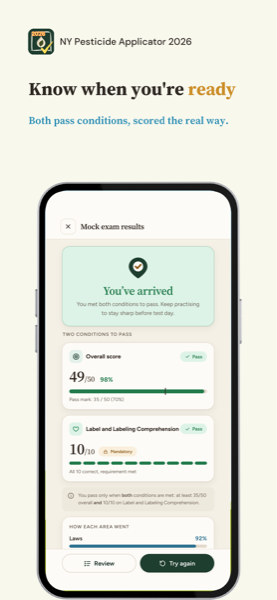
You need 35 of the 50 questions correct, which is 70 percent. There is also a special label rule: 10 of the 50 questions are about reading the pesticide label, and you must get at least 7 of those 10 correct in addition to the overall score.
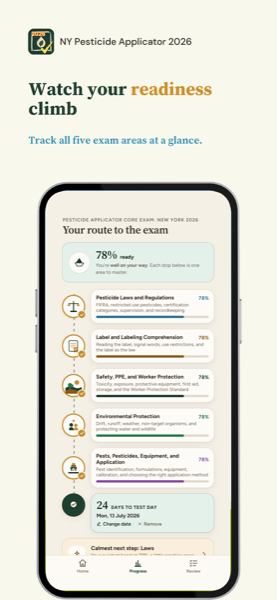
The questions cover the knowledge every applicator must have before handling restricted use pesticides.
Work through hundreds of questions by topic, with a clear explanation and a source reference on every answer so you learn why it is right.
Sit a timed 50-question mock that mirrors the real format, including the rule that you must pass the label questions as well as the overall score.
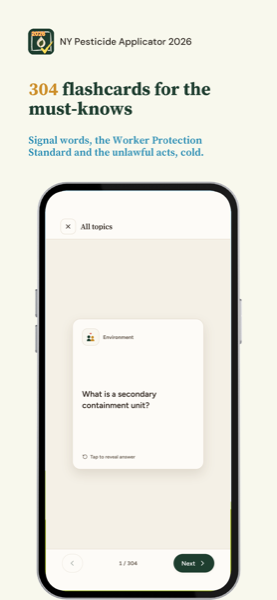
Drill the key definitions and rules, from signal words and restricted-entry intervals to the unlawful acts under FIFRA, with a deck of more than 300 cards.
| Based on the official public source | Yes, United States pesticide law: FIFRA (7 U.S.C. 136 et seq.) and the EPA regulations in Title 40 of the Code of Federal Regulations, Parts 152, 156, 165, 170 and 171 |
|---|---|
| Timed mock exam | 50 questions, 90 min |
| Pass rule applied | 70% to pass, all 10 mandatory questions correct |
| Answer explanations mapped to the source | Yes |
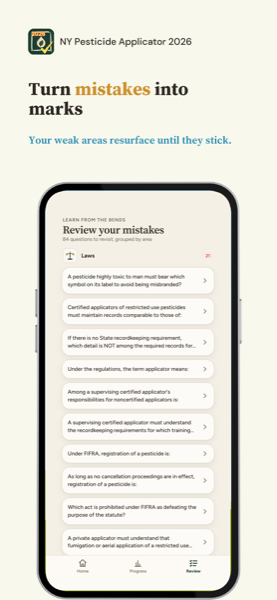
| Weak-area review | Yes |
| Flashcards (spaced repetition) | Yes |
| Works fully offline, no account | Yes |
| Ads | None |
| Payment | One-time purchase |
| Last content review | 2026-06-17 |
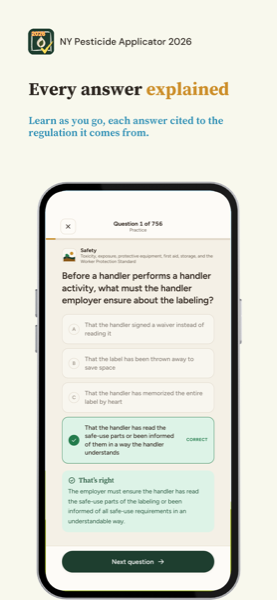
Tap an answer to see why it is right, mapped to the official source, exactly as in the app.
What does Part 171 establish Federal standards for?
Based on: 40 CFR 171.1 (Scope)
A restricted use pesticide is a pesticide that has been classified for restricted use under which authority?
Based on: 40 CFR 171.3 and FIFRA 3(d)
Under FIFRA, what does it mean when applicators say that the pesticide label is the law?
Based on: 40 CFR 156.10(i)(2)(ii); FIFRA 12(a)(2)(G)
Which item is part of the information a pesticide label is required to display?
Based on: 40 CFR 156.10(a)(1)
According to the core safety standards, a pesticide's risk is best described as a function of which two things?
Based on: 40 CFR 171.103(c)(2)(ii)
If a pesticide's toxicity cannot be changed, how can an applicator still reduce the risk it poses?
Based on: 40 CFR 171.103(c)(2)
An applicator wants to reduce spray drift. Which change to the spray would most directly help?
Based on: 40 CFR 171.103(c)(3)(i) and (c)(7)(iv)
What is runoff in the context of pesticide environmental movement?
Based on: 40 CFR 165 (Runoff definition)
When cleaning application equipment, where should the rinse water be directed?
Based on: 40 CFR 171.3 and 156.85
What is the first step in effective pest control before a pesticide is selected?
Based on: 40 CFR 171.103(c)(4) (Pests)
Prefer to start in your browser? Work free, topic-by-topic practice questions and use our free calculators, no download needed, then unlock the full bank in the app.
Built from United States pesticide law: FIFRA (7 U.S.C. 136 et seq.) and the EPA regulations in Title 40 of the Code of Federal Regulations, Parts 152, 156, 165, 170 and 171 (Current United States federal pesticide law and regulations (FIFRA and 40 CFR)), the official public source, used under Public domain (United States federal law and regulations; 17 U.S.C. 105 and 1 CFR 2.6). View the official source .
Last checked against the source: 2026-06-17.
All questions are original and written from the public source. No official exam questions are copied.
No. This is an independent study aid. It is not affiliated with or endorsed by the New York State Department of Environmental Conservation or the United States Environmental Protection Agency. The questions are original and are based on public United States pesticide law and federal regulations.
The app includes 756 practice questions and 304 flashcards, for more than 1,000 study items covering all five core topic areas.
Yes. Everything is stored on your device, so you can study without an internet connection and there is no login or account to create.
Use the restore purchase option in the app. The one-time purchase is tied to your app store account, so you can restore it on any device that uses the same account.
You need at least 35 of 50 questions correct, which is 70 percent, and you must also get at least 7 of the 10 label questions correct.
Yes. The content is built from FIFRA and the current federal regulations in Title 40 of the Code of Federal Regulations, which are the laws the core exam is based on.
Every question is written from the official public materials for this exam and cites the source passage it comes from. Before it ships, a second, independent AI model from a different family confirms that the cited passage supports the answer, and a human reviews anything the two models disagree on. You can read the full process at rivermaplearning.com/how-we-build-questions, and the free sample questions above let you judge the quality before you buy.
No. It is an independent study tool, not affiliated with or endorsed by the US Environmental Protection Agency or the New York State Department of Environmental Conservation. It is built from publicly available official materials (FIFRA and Title 40 of the Code of Federal Regulations); the questions are original, and we never copy the real exam's own questions.
No study tool can promise that. Our practice mock mirrors the official format and pass mark where the authority publishes one, and clearly labels any practice length or pass mark that is our own rehearsal format rather than an official figure. Use the app alongside the official study materials, not instead of them.
Free, in-depth answers written from the same official sources the app is built on.
The NY pesticide core exam is 50 questions in 90 minutes with a 70% pass mark and a mandatory label section. This step-by-step plan covers exactly what to study.
50 questions, 90 minutes, 70% pass mark plus a mandatory label sub-score. Everything you need to know about the New York pesticide applicator core exam.
The New York pesticide applicator core exam is 50 questions in 90 minutes. You need 35 correct overall and at least 7 of the 10 label questions. Here is what you need to know.
One purchase. Every question. Yours offline, forever.
This app is not affiliated with or endorsed by the United States Environmental Protection Agency or the New York State Department of Environmental Conservation. It is an independent study aid based on public-domain United States federal law and regulations (FIFRA and Title 40 of the Code of Federal Regulations). The pass mark used in practice mocks is an unofficial study target based on the New York DEC core exam information: 35 of 50 correct (70 percent), including at least 7 of the 10 label questions.