
Who has the authority to appoint and commission notaries public in Hawaii?
Based on: commission_qualifications
Prepare for the Hawaii notary public examination with hundreds of practice questions and flashcards built from the actual law: HRS Chapter 456, HRS sections 502-41 to 502-74, and HAR Chapter 5-11, with every question cited to the passage it comes from.
The Hawaii notary public examination is a closed-book written test administered by the Department of the Attorney General. It checks whether you have a reasonable knowledge of the statutes and rules that govern notarial acts in Hawaii.
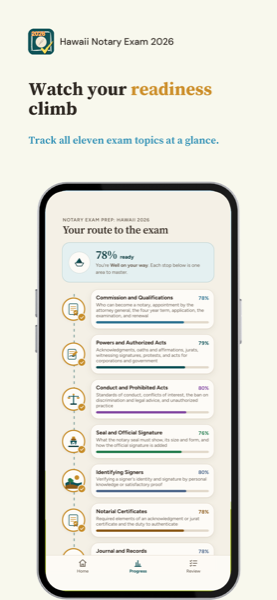
The examination tests the law and practice of notarial acts in Hawaii, drawn from three open-law sources.
The minimum passing score is 80 percent. Hawaii Administrative Rules section 5-11-32 requires at least eighty per cent of the questions to be answered correctly.
The Department of the Attorney General does not publish the official number of questions or the time limit. Our practice mock uses 50 questions in 60 minutes so you can rehearse a full sitting, and you must answer 40 of 50 correctly to clear the same 80 percent bar.
Examinations on Oahu are usually held on the second Wednesday of each month. On the neighbor islands the examinations are held quarterly.
Several nonrefundable fees apply under Hawaii Administrative Rules section 5-11-46, on top of the required bond.
An applicant who fails the examination twice must wait ninety days from the date of the last examination before reapplying. A Hawaii notary commission runs for a four year term.
392 original questions across all eleven topics the exam tests, with a plain-English explanation and a statute citation (HRS 456, HRS 502 or HAR 5-11) on every answer.
Sit a timed 50-question mock scored at the real 80 percent pass mark, drawn fresh across every topic and weighted to the law the exam covers.
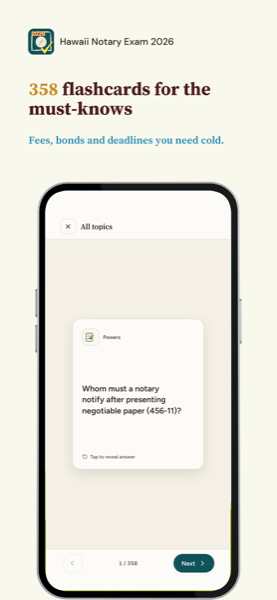
Drill the fees, deadlines, seal elements and acknowledgment forms as quick front-and-back cards: the $1,000 bond, the 80 percent pass mark, the ten-year journal retention, the $5 acknowledgment fee and hundreds more.
| Based on the official public source | Yes, Hawaii Revised Statutes Chapter 456 (Notaries Public) and sections 502-41 to 502-74 (Acknowledgments), with Hawaii Administrative Rules Chapter 5-11 (Notaries Public) |
|---|---|
| Timed mock exam | 50 questions, 60 min |
| Pass rule applied | 80% to pass |
| Answer explanations mapped to the source | Yes |
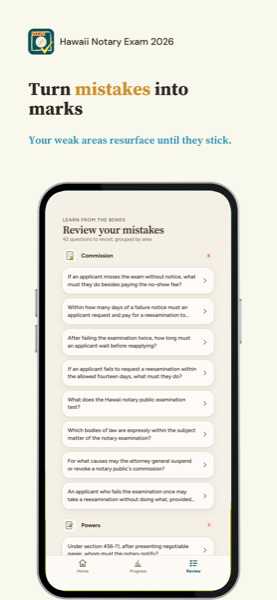
| Weak-area review | Yes |
| Flashcards (spaced repetition) | Yes |
| Works fully offline, no account | Yes |
| Ads | None |
| Payment | One-time purchase |
| Last content review | 2026-06-17 |
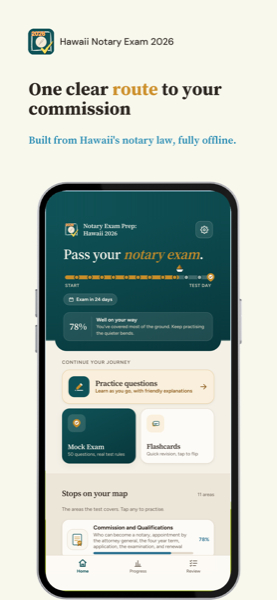
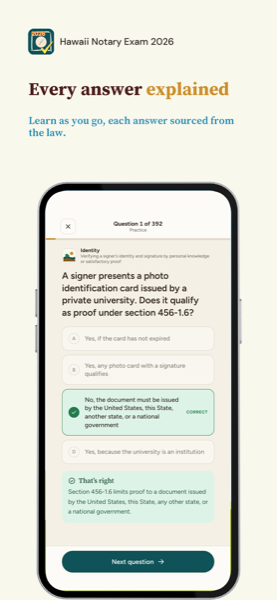
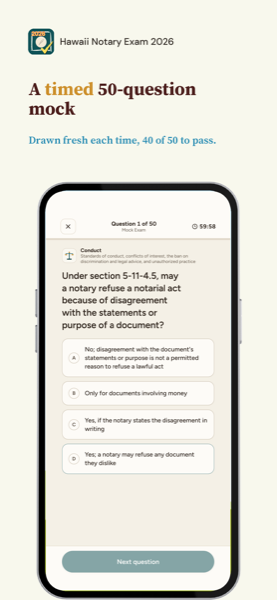
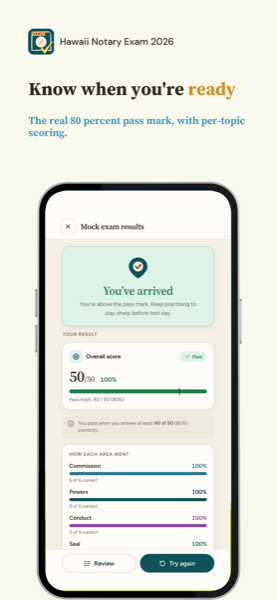
Tap an answer to see why it is right, mapped to the official source, exactly as in the app.
Who has the authority to appoint and commission notaries public in Hawaii?
Based on: commission_qualifications
What is the minimum passing score on the Hawaii notary public examination?
Based on: commission_qualifications
Which acts may every Hawaii notary public perform?
Based on: powers_authorized_acts
When may a Hawaii notary give legal advice?
Based on: prohibited_acts_conduct
What must a Hawaii notary's seal clearly show?
Based on: seal_and_signature
What counts as proof of a signer's signature and identity in Hawaii?
Based on: identifying_signers
How must every acknowledgment or jurat be evidenced in Hawaii?
Based on: notarial_certificates
How long must a Hawaii notary retain the journal after the last notarial act?
Based on: journal_and_records
Before a conveyance may be recorded in Hawaii, what must be attached to it?
Based on: acknowledgment_law_502
What fee may a Hawaii notary charge for taking an acknowledgment, per party signing?
Based on: fees
Under section 456-4, what three items must a notary file with the clerk of the circuit court?
Based on: bond_filing_liability
Within how many days must a notary notify the attorney general in writing of a change in the information on file, such as address or employer?
Based on: discipline_penalties
Prefer to start in your browser? Work free, topic-by-topic practice questions and use our free calculators, no download needed, then unlock the full bank in the app.
Built from Hawaii Revised Statutes Chapter 456 (Notaries Public) and sections 502-41 to 502-74 (Acknowledgments), with Hawaii Administrative Rules Chapter 5-11 (Notaries Public) (Current Hawaii statutes and administrative rules, 2026), the official public source, used under Public domain (United States government edicts doctrine, Georgia v. Public.Resource.Org). View the official source .
Last checked against the source: 2026-06-17.
All questions are original and written from the public source. No official exam questions are copied.
No. This is an independent study aid. It is not affiliated with or endorsed by the State of Hawaii or the Department of the Attorney General. The questions are original and based on publicly available Hawaii law.
Hawaii requires a minimum score of 80 percent, set by HAR 5-11-32. Our mock exam uses the same 80 percent bar so your practice reflects the real standard.
The Department of the Attorney General does not publish the official question count or time limit. Our practice mock uses 50 questions in 60 minutes, with 40 of 50 needed to pass at the official 80 percent bar.
392 multiple-choice questions and 358 flashcards, 750 study items in total, covering HRS Chapter 456, HRS sections 502-41 to 502-74, and HAR Chapter 5-11.
Yes. Everything is stored on your device, so you can study without an internet connection. There is no account and no login.
Use the Restore Purchases option on the app's start screen. The one time purchase is tied to your app store account.
No. Remote online notarization is a separate Hawaii commission with its own examination, so this study aid focuses on the traditional notary public exam.
Every question is written from the official public materials for this exam and cites the source passage it comes from. Before it ships, a second, independent AI model from a different family confirms that the cited passage supports the answer, and a human reviews anything the two models disagree on. You can read the full process at rivermaplearning.com/how-we-build-questions, and the free sample questions above let you judge the quality before you buy.
No. It is an independent study tool, not affiliated with or endorsed by the State of Hawaii or the Department of the Attorney General. It is built from publicly available official materials (Hawaii Revised Statutes Chapter 456, HRS sections 502-41 to 502-74, and Hawaii Administrative Rules Chapter 5-11); the questions are original, and we never copy the real exam's own questions.
No study tool can promise that. Our practice mock mirrors the official format and pass mark where the authority publishes one, and clearly labels any practice length or pass mark that is our own rehearsal format rather than an official figure. Use the app alongside the official study materials, not instead of them.
Free, in-depth answers written from the same official sources the app is built on.
The Hawaii notary exam pass mark is 80 percent. Direct answers on retakes, rescheduling fees, the surety bond, commission renewal, and what happens if you're suspended.
The Hawaii notary exam is 50 questions in 60 minutes with an 80% pass mark. Candidates who fail tend to trip on a short list of specific rules from three source laws.
To become a Hawaii notary public you must be 18, a state resident, and a US citizen or authorized worker. Here is the full eligibility checklist and what to submit.
The Hawaii notary public exam is a closed-book written test on state law. Learn what it covers, the 80 percent pass mark, exam dates, fees, and what to expect.
A practical study plan for the Hawaii notary public exam: what to study, how to pace your prep across eleven tested topics, and how to clear the 80 percent pass mark.
The Hawaii notary exam requires 80 percent to pass, set by HAR 5-11-32. Here is what the exam covers, how it is scheduled, the fees, and what happens if you need to retake.
One purchase. Every question. Yours offline, forever.
This app is not affiliated with, endorsed by, or sponsored by the State of Hawaii or the Hawaii Department of the Attorney General. It is an independent study aid based on publicly available Hawaii law (Hawaii Revised Statutes Chapter 456 and sections 502-41 to 502-74, and Hawaii Administrative Rules Chapter 5-11), which is in the public domain as government edicts.