
For 2025, what is the basic standard deduction for a single taxpayer?
Based on: IRS Publication 501 (2025), Standard Deduction Amount
A study app for the Enrolled Agent exam covering all three parts: Individuals, Businesses, and Representation, Practices and Procedures. Every question is written from public domain IRS publications, the Internal Revenue Code and Circular 230, and cites the passage it came from.
The Special Enrollment Examination (SEE) is the three part test that lets you become an enrolled agent, the only tax credential issued directly by the IRS. Passing all three parts, plus a tax compliance and suitability check, gives you unlimited practice rights before the IRS. There is no degree or experience requirement to sit it: anyone with a PTIN can register.
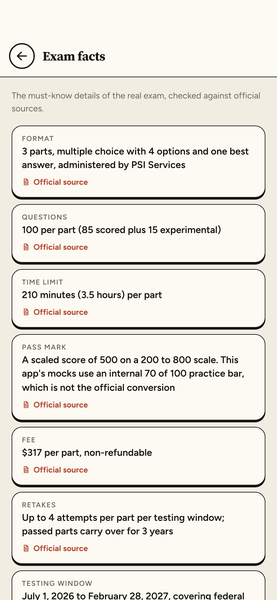
You need a scaled score of 500. Each part is reported on a scale that runs from 200 to 800, and the IRS has set 500 as the minimum level of knowledge it considers acceptable. A scaled score is not a percentage, so there is no published number of questions that guarantees a pass. This app's mocks score you against an internal 70 of 100 practice bar, which is a study threshold we chose and not the official conversion. We would rather say that than invent a percentage.
Each part has 100 multiple choice questions and lasts 3.5 hours. Only 85 of the 100 are scored; the other 15 are experimental questions being trialled for future exams, and they are not identified on screen, so you have to treat every question as if it counts.
It tests calendar year 2025. For exams taken between 1 July 2026 and 28 February 2027, every reference is to the Internal Revenue Code, regulations, forms and publications as amended through 31 December 2025, and candidates are told not to consider any legislation, court decision or penalty amount after that date. This matters more than usual for the current window, because the One Big Beautiful Bill Act changed a long list of 2025 figures: the child tax credit, the SALT cap, the section 179 limits, and the new deductions for tips, overtime and car loan interest. Every dollar amount in this app is keyed to that 2025 basis, and prior year amounts appear only as wrong answers, which is exactly how the real exam uses them.
The IRS publishes the number of scored questions per topic area, and it is uneven enough to change how you should study. Business Tax Preparation alone is 37 of the 85 scored questions on Part 2, while Filing Process is 14 of 85 on Part 3. The mock in this app draws its 100 questions in these same proportions.
PSI Services. Effective 1 March 2026 the IRS moved the SEE away from Prometric, which had run it for years, and appointed PSI to develop and administer it. Registration and scheduling for the 2026 test cycle go through PSI, and older guides that tell you to book through Prometric are out of date. The exam content and the three part structure did not change with the vendor.
Work through 1,125 questions by topic across all 13 areas of the SEE blueprint, with an explanation and a cited IRS passage behind every answer.
Sit a timed 100 question, 3.5 hour mock drawn in the same topic proportions the IRS publishes for the real parts.
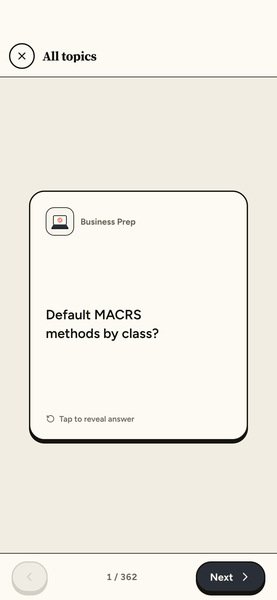
Drill the 362 figures the exam turns into questions: thresholds, caps, rates, deadlines and the Circular 230 section numbers.
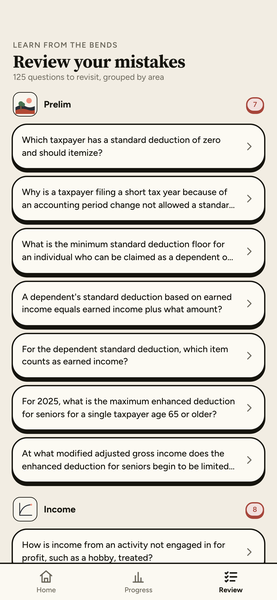
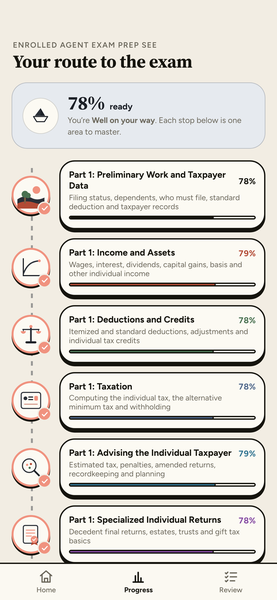
Every question you miss goes to a focused review list, and a readiness score tracks each of the 13 topic areas separately.
| Based on the official public source | Yes, IRS publications (17, 225, 334, 501, 502, 503, 505, 525, 541, 542, 544, 550, 556, 557, 559, 560, 594, 596, 936, 946, 947, 970, 1660, 3402), the Instructions for Schedule 8812, Treasury Circular No. 230 (31 CFR Part 10), and the Internal Revenue Code and Treasury Regulations as reflected in those materials |
|---|---|
| Timed mock exam | 100 questions, 210 min |
| Pass rule applied | 70% to pass |
| Answer explanations mapped to the source | Yes |
| Weak-area review | Yes |
| Flashcards (spaced repetition) | Yes |
| Works fully offline, no account | Yes |
| Ads | None |
| Payment | One-time purchase |
| Last content review | 2026-08-05 |
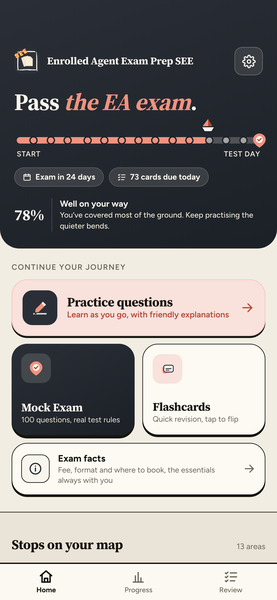
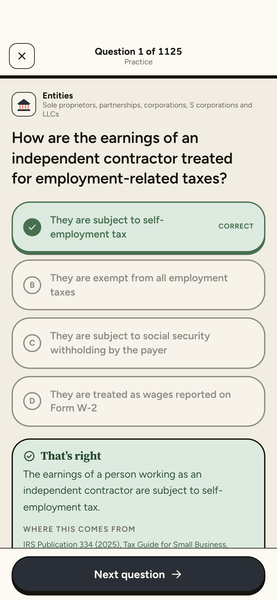
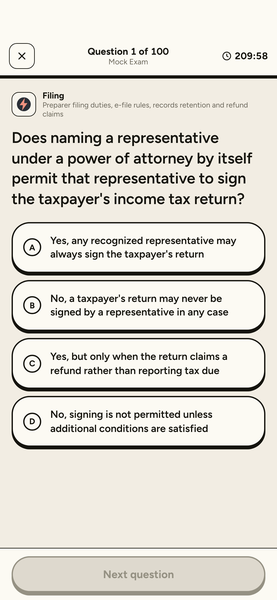
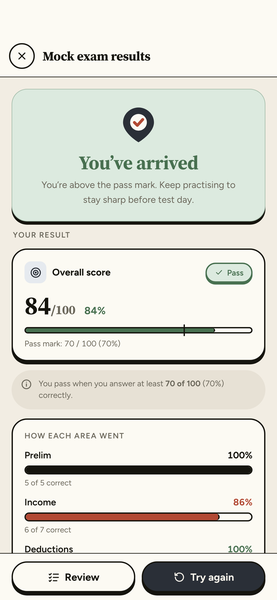
Tap an answer to see why it is right, mapped to the official source, exactly as in the app.
For 2025, what is the basic standard deduction for a single taxpayer?
Based on: IRS Publication 501 (2025), Standard Deduction Amount
For federal tax purposes, how are digital assets such as convertible virtual currency treated?
Based on: Notice 2014-21; IRS Publication 544 (2025)
What is the 2025 cap on the itemized deduction for state and local taxes for a single filer?
Based on: IRC section 164(b)(6) as amended by P.L. 119-21
What is the NIIT threshold for a Married filing jointly or Qualifying surviving spouse taxpayer?
Based on: IRS Publication 505 (2026), Net Investment Income Tax
How can a married couple change from separate returns to a joint return for a year already filed?
Based on: IRS Publication 501 (2025), Changing filing status
What is the basic exclusion amount for decedents who died in 2025?
Based on: IRS Publication 559 (2025), Applicable Credit and Basic Exclusion Amount
How long may a corporation carry over charitable contributions that exceed the 10 percent limit?
Based on: IRS Publication 542 (2024), Carryover of excess contributions
In 2025 a business places $4,050,000 of section 179 property in service. What is its section 179 dollar limit after the investment reduction?
Based on: IRS Publication 946 (2025), How To Depreciate Property
A section 501(c)(3) organization loses eligibility if any part of its net earnings does what?
Based on: IRS Publication 557 (2024), Tax-Exempt Status for Your Organization
What is a censure under Circular 230?
Based on: Treasury Circular No. 230 (Rev. 6-2014), section 10.50(a)
A taxpayer generally cannot petition the United States Tax Court until the IRS has issued what?
Based on: IRS Publication 556, Examination of Returns, Appeal Rights, and Claims for Refund
For 2025, a seriously delinquent tax debt that can trigger passport action exceeds what amount?
Based on: Revenue Procedure 2024-40; IRS Publication 594, The IRS Collection Process
How soon after e-filing a return is the refund status usually available in Where's My Refund?
Based on: IRS Publication 556, Refund information
Prefer to start in your browser? Work free, topic-by-topic practice questions and use our free calculators, no download needed, then unlock the full bank in the app.
Built from IRS publications (17, 225, 334, 501, 502, 503, 505, 525, 541, 542, 544, 550, 556, 557, 559, 560, 594, 596, 936, 946, 947, 970, 1660, 3402), the Instructions for Schedule 8812, Treasury Circular No. 230 (31 CFR Part 10), and the Internal Revenue Code and Treasury Regulations as reflected in those materials (Keyed to the tax law tested in the 1 July 2026 to 28 February 2027 window: the Code, regulations, forms and publications as amended through 31 December 2025, including the One Big Beautiful Bill Act (P.L. 119-21)), the official public source, used under Works of the United States Government are in the public domain under 17 U.S.C. 105, so IRS publications, the Internal Revenue Code, Treasury Regulations and Circular 230 may be reproduced, adapted and built on freely. This app is written from those primary materials, not from any commercial review course. The IRS does publish sample SEE questions; those were deliberately not ingested, and every question here is original wording drawn from a cited passage.. View the official source .
Last checked against the source: 2026-08-05.
All questions are original and written from the public source. No official exam questions are copied.
No. This is an independent study aid. It is not affiliated with, authorized by, or endorsed by the Internal Revenue Service, the U.S. Department of the Treasury or PSI Services. It is built from public domain federal tax materials.
A scaled score of 500. Each part is reported on a 200 to 800 scale and the IRS sets 500 as the pass mark. Because it is a scaled score rather than a percentage, no fixed number of correct answers guarantees a pass.
100 multiple choice questions per part, of which 85 are scored and 15 are experimental. You get 3.5 hours per part.
$317 per part, paid to PSI Services when you schedule. The fee is non-refundable, and you may take each part up to four times within a testing window.
Calendar year 2025. Exams taken between 1 July 2026 and 28 February 2027 test the law as amended through 31 December 2025, so the 2025 figures changed by the One Big Beautiful Bill Act are the ones that count.
Yes. It covers all 13 topic areas of the SEE blueprint across Part 1 Individuals, Part 2 Businesses, and Part 3 Representation, Practices and Procedures, with 1,125 questions and 362 flashcards.
Yes. Once downloaded, the full question bank, flashcards and mock exam work without an internet connection, and your progress stays on your device.
Every question is written from IRS publications, the Internal Revenue Code, Treasury Regulations and Circular 230, which are public domain works of the U.S. government under 17 U.S.C. 105. Each question cites the passage it is based on. The IRS sample SEE questions were not used.
Yes. Use the restore purchase option on the store account you bought the app with and your access carries over.
Free, in-depth answers written from the same official sources the app is built on.
Each part of the IRS Special Enrollment Examination has 100 questions, 85 scored, in 3.5 hours. The pass mark is a scaled score of 500 on a 200 to 800 scale.
One purchase. Every question. Yours offline, forever.
This app is not affiliated with, authorized by, or endorsed by the Internal Revenue Service, the U.S. Department of the Treasury, or PSI Services. It is an independent study aid based on public domain U.S. federal tax materials, including IRS publications, the Internal Revenue Code, Treasury Regulations and Treasury Circular No. 230, which are works of the United States Government under 17 U.S.C. 105. The real Special Enrollment Examination is scored on a 200 to 800 scale with a scaled passing score of 500 set by the IRS; the 70 of 100 pass bar used in this app's practice mocks is an internal study threshold only, not the official scaled conversion. Exam facts on this page were verified on 5 August 2026 against the SEE Candidate Information Bulletin and are subject to change by the IRS and PSI.