
The price of coffee falls and shoppers buy more coffee. This is
Based on: DSE Econ Compulsory C: Change in quantity demanded versus change in demand
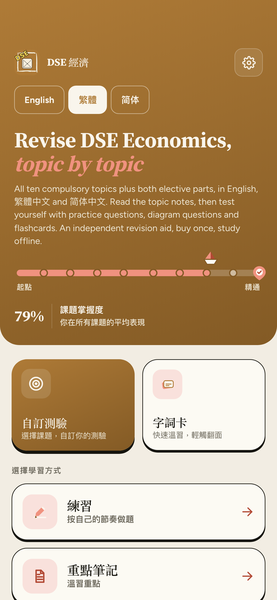
Revise HKDSE Economics topic by topic, in English, 繁體中文 and 简体中文. 304 original questions across all fourteen topics, 193 flashcards, a one-page note for every topic, and 20 diagram questions drawn from scratch for this app. Every question is written to the publicly available topic framework in the EDB Curriculum and Assessment Guide, never copied from a past paper.
HKDSE Economics is assessed entirely by public examination; there is no school-based assessment. The curriculum has a Compulsory Part of ten topics, labelled A to J, and an Elective Part of two units from which a candidate takes one. The Curriculum and Assessment Guide was updated in 2025, but that update changed the assessment design only: the topic framework and the suggested lesson time for every compulsory topic are word for word what they were in the 2015 edition.
Paper 1 is multiple-choice, weighted 30% and lasting one hour. Paper 2 is a conventional paper lasting two hours 30 minutes and carrying the remaining 70%. From the 2028 examination Paper 2 is split into three sections: Section A short questions on the Compulsory Part (26%), Section B structured, essay-type and data-response questions on the Compulsory Part (33%), and Section C on the Elective Part (11%), where candidates answer questions from one of the two elective parts. For the 2026 and 2027 examinations, Paper 2 keeps the earlier arrangement: Part 1 on the Compulsory Part and Part 2 on the Elective Part, together weighted 70%.
From Secondary 4 in the 2025/26 school year, which is the 2028 HKDSE, students may choose to study the Compulsory Part only. The Guide notes that strong performance on the Compulsory Part questions can still reach Level 5, and that candidates with the same score receive the same grade whether or not they answered the Elective Part. This app covers all four elective topics anyway, so it works either way.
The Curriculum and Assessment Guide fixes the 30% weighting and the one-hour duration for Paper 1, but it does not fix a number of questions. Check the Regulations and Assessment Frameworks published by the HKEAA for the year you are sitting.
Ten compulsory topics and two elective units. The compulsory topics are Basic Economic Concepts; Firms and Production; Market and Price; Competition and Market Structure; Efficiency, Equity and the Role of Government; Measurement of Economic Performance; National Income Determination and Price Level; Money and Banking; Macroeconomic Problems and Policies; and International Trade and Finance. Elective Part 1 is Monopoly Pricing together with Anti-competitive Behaviours and Competition Policy; Elective Part 2 is Extension of Trade Theory together with Economic Growth and Development.
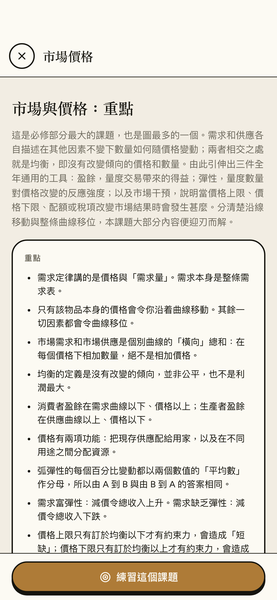
Revise each of the fourteen topics from a one-page note: the must-know points, the key terms in English and Traditional Chinese, and the mistakes that cost marks, before you touch a question.
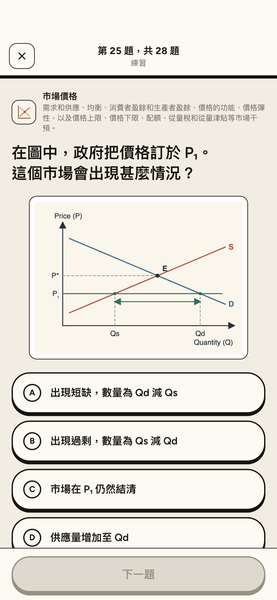
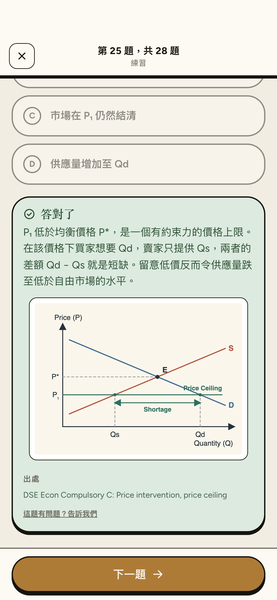
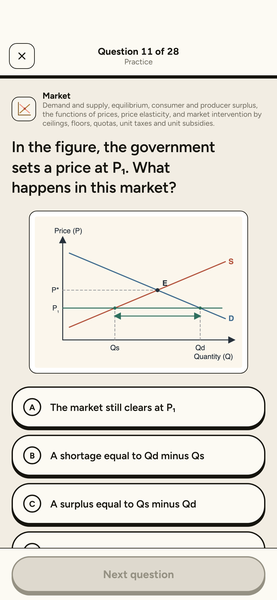
Economics is a diagram subject, and a fully labelled diagram often gives its own answer away. So the figure you answer against is deliberately neutral, and the annotated version appears only in the explanation, once you have committed.
Work through all 304 questions by topic, each tagged recall or application, with an explanation on every answer that says why the right answer is right and why the tempting wrong one is wrong.
Switch the whole app between three languages with one tap. Questions, options, explanations, notes and flashcards are all available in each, with Hong Kong textbook terminology throughout.
| Based on the official public source | Yes, Economics Curriculum and Assessment Guide (Secondary 4-6), Curriculum Development Council and HKEAA |
|---|---|
| Timed mock exam | 50 questions, 60 min |
| Pass rule applied | 60% to pass |
| Answer explanations mapped to the source | Yes |
| Weak-area review | Yes |
| Flashcards (spaced repetition) | Yes |
| Works fully offline, no account | Yes |
| Ads | None |
| Payment | One-time purchase |
| Last content review | 2026-08-05 |
Tap an answer to see why it is right, mapped to the official source, exactly as in the app.
The price of coffee falls and shoppers buy more coffee. This is
Based on: DSE Econ Compulsory C: Change in quantity demanded versus change in demand
A shop cuts its price and finds total revenue rises. Demand over that range must be
Based on: DSE Econ Compulsory C: Price elasticity and total revenue
A market outcome is efficient when
Based on: DSE Econ Compulsory E: Conditions for efficiency
An economy's GDP is $800 billion and net income from abroad is $40 billion. Its GNI is
Based on: DSE Econ Compulsory F: GNI as GDP plus net income from abroad
A student can spend Saturday on a paid shift worth $400, a revision class worth $300 to her, or a hike worth $250 to her. She chooses the revision class. What is her opportunity cost?
Based on: DSE Econ Compulsory A: Choice and opportunity cost
In economics, the short run is defined as a period in which
Based on: DSE Econ Compulsory B: Definition of short run and long run
If the required reserve ratio is 20%, the banking multiplier is
Based on: DSE Econ Compulsory H: Credit creation and the banking multiplier
The nominal interest rate is 5% and inflation is 3%. The real interest rate is approximately
Based on: DSE Econ Compulsory I: Nominal and real interest rates
Country X is less productive than Country Y at making both cloth and rice. Can the two still gain from trade?
Based on: DSE Econ Compulsory J: Gains from trade
A simple monopoly maximises profit by producing where
Based on: DSE Econ Elective 1: Determination of price, output and monopoly profit
Prefer to start in your browser? Work free, topic-by-topic practice questions and use our free calculators, no download needed, then unlock the full bank in the app.
Built from Economics Curriculum and Assessment Guide (Secondary 4-6), Curriculum Development Council and HKEAA (2007, with updates in 2025, effective from Secondary 4 in the 2025/26 school year), the official public source, used under The Guide is referenced only to align topic coverage. All questions, explanations, notes and diagrams are 100% original; no HKEAA past papers, marking schemes or Guide text is reproduced. Economic definitions and facts are not copyrightable.. View the official source .
Last checked against the source: 2026-08-05.
All questions are original and written from the public source. No official exam questions are copied.
No. This is an independent revision aid. It is not affiliated with, endorsed by, or sponsored by the HKEAA, the Education Bureau, the Curriculum Development Council, or the Government of the Hong Kong SAR. It is written to align with the publicly available HKDSE Economics topic framework, but every question, explanation and diagram is our own.
No. Comparing the 2025-updated Guide with the 2015-updated edition line by line, sections 2.2.1 and 2.2.2, the Compulsory Part and the Elective Part, are identical apart from page numbers, and the suggested lesson time for every compulsory topic is unchanged. The 2025 update changes the assessment design, and only from the 2028 examination.
No. Both the pre-2028 and the 2028 assessment designs consist of public examination components only.
From Secondary 4 in the 2025/26 school year, which is the 2028 HKDSE, you may choose to study the Compulsory Part only. The Guide notes that good performance on the Compulsory Part questions can still reach Level 5, and that the same score gives the same grade whether or not you answered the Elective Part. This app covers both elective parts, so it suits either choice.
The Curriculum and Assessment Guide does not fix a number. It sets the 30% weighting and the one-hour duration. Check the HKEAA Regulations and Assessment Frameworks for your examination year.
No. Every diagram is generated from scratch for this app by a script that solves each curve intersection algebraically rather than placing it by eye, and that refuses to draw a figure whose economic shape is wrong. No textbook, past paper or marking scheme figure is traced or reproduced.
No. One purchase unlocks the whole app permanently. Every topic has free questions and flashcards you can try before buying, there are no ads, no account and no network connection is needed.
Free, in-depth answers written from the same official sources the app is built on.
HKDSE Economics has no fixed question count or pass mark. Paper 1 is multiple-choice (30%), Paper 2 is conventional (70%), both graded on the Level scale.
One purchase. Every question. Yours offline, forever.
This app is not affiliated with, endorsed by, or sponsored by the HKEAA, the Education Bureau (EDB), the Curriculum Development Council, or the Government of the Hong Kong SAR. It is an independent revision aid aligned to the publicly available HKDSE Economics topic framework. Every question and every diagram is original; no HKEAA past papers, marking schemes, or official curriculum guide text is reproduced. Always check the current syllabus and exam arrangements with the HKEAA and your school.