What is a requirement of all marine transmitting apparatus used aboard United States vessels?
Based on: FCC pool 1-1A1
Study for five FCC commercial radio operator licences in one app: the GROL, the GMDSS Radio Operator's and Restricted licences, the Ship Radar Endorsement and the GMDSS Maintainer's licence. Pick your licence and it draws the right elements. Every question is the real, word-for-word FCC pool question with the official answer, plus an explanation we write ourselves, so what you study is exactly what the exam tests.
The FCC commercial radio operator licences let you operate, adjust, maintain and internally repair the radiotelephone transmitters used in the maritime and aviation services, and many radar and two-way radio jobs ask for one. They are not the amateur (ham) radio licence. Each licence is earned by passing a set of written exam elements, and every question is drawn from the FCC's published commercial operator question pools. This app covers five of these licences in one place.
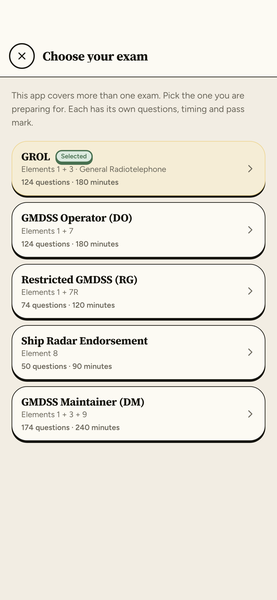
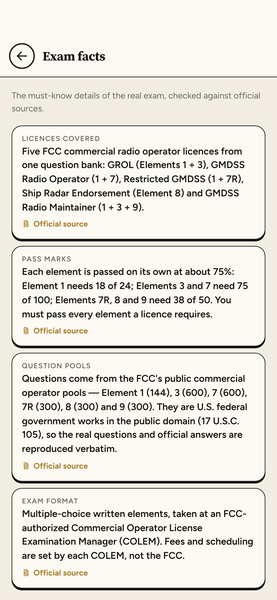
It covers the five licences built from Elements 1, 3, 7, 7R, 8 and 9. Pick your licence in the app and the mock draws exactly the elements that licence requires, each at its official pass mark.
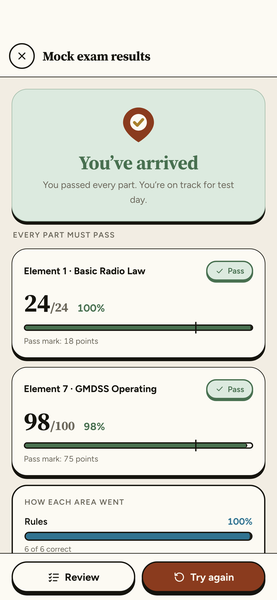
You must pass two separate elements. Element 1 (Basic Radio Law and Operating Practice) has 24 questions and you need 18 correct. Element 3 (General Radiotelephone) has 100 questions and you need 75 correct. Both work out to 75 percent, and you must pass both to be issued the licence.
The GMDSS licences add their own elements on top of Element 1, and each is passed at about 75 percent, the same bar as the GROL elements.
Every question is drawn from the FCC's public commercial operator question pools for Elements 1, 3, 7, 7R, 8 and 9. These pools are works of the United States federal government and are in the public domain, so this app reproduces the real questions word for word with the official correct answer, and adds an explanation of its own. It ships all 2,244 pool questions, including the Element 8 items that are answered from a printed radar diagram, which are shown with their diagrams.
Element 3 is the technical element behind the GROL and the GMDSS Maintainer's licence. Its 600 questions span the full range of radiotelephone electronics, from basic theory to complete systems.
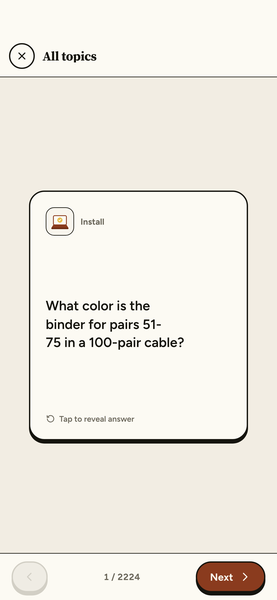
Work through all 2,244 real pool questions by topic, with a clear explanation on every answer so you learn why it is right, not just which letter to pick.
Choose GROL, GMDSS Operator, Restricted GMDSS, Ship Radar or GMDSS Maintainer, and the timed mock draws exactly that licence's elements at the official topic weighting, each element gated at its own pass mark.
Drill the formulas, definitions and rules, from Ohm's law and emission designators to the GMDSS distress procedures, with a deck of 2,244 cards.
| Based on the official public source | Yes, FCC commercial radio operator license question pools for Elements 1, 3, 7, 7R, 8 and 9 |
|---|---|
| Timed mock exam | 124 questions, 180 min |
| Pass rule applied | 75% to pass |
| Answer explanations mapped to the source | Yes |
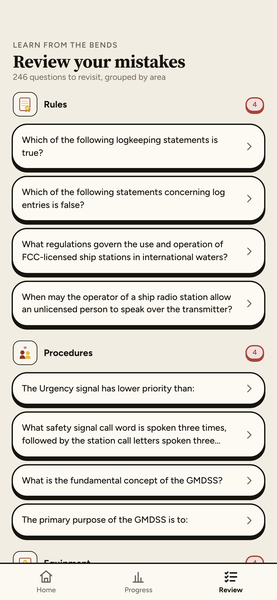
| Weak-area review | Yes |
| Flashcards (spaced repetition) | Yes |
| Works fully offline, no account | Yes |
| Ads | None |
| Payment | One-time purchase |
| Last content review | 2026-08-20 |
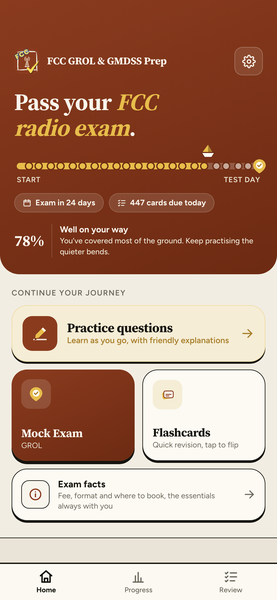
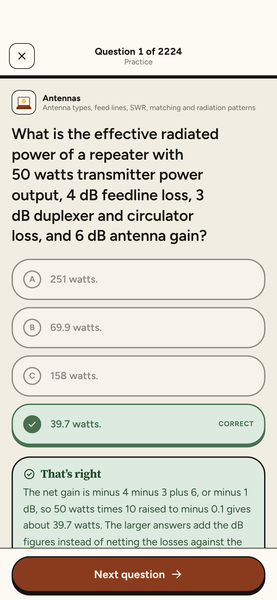
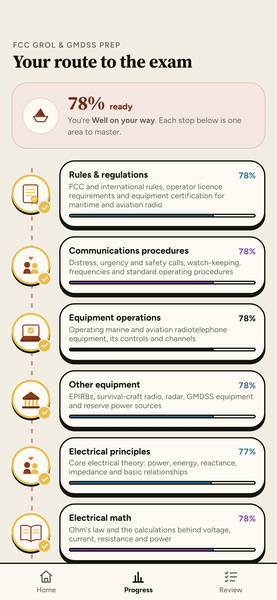
Tap an answer to see why it is right, mapped to the official source, exactly as in the app.
What is a requirement of all marine transmitting apparatus used aboard United States vessels?
Based on: FCC pool 1-1A1
What traffic management service is operated by the U.S. Coast Guard in certain designated water areas to prevent ship collisions, groundings and environmental harm?
Based on: FCC pool 1-7B1
The product of the readings of an AC voltmeter and AC ammeter is called:
Based on: FCC pool 3-1A1
What happens to the conductivity of photoconductive material when light shines on it?
Based on: FCC pool 3-19C1
What is the limiting condition for sensitivity in a communications receiver?
Based on: FCC pool 3-41F1
Which of the following could cause a high standing wave ratio on a transmission line?
Based on: FCC pool 3-63J1
What is the channel spacing used for VHF marine radio?
Based on: FCC pool 3-85N1
What is the normal range of pulse repetition rates?
Based on: FCC pool 3-90O1
Compliance with MPE, or Maximum Permissible Exposure to RF levels (as defined in FCC Part 1, OET Bulletin 65) for “controlled” environments, are averaged over _______ minutes, while “uncontrolled” RF environments are averaged over ______ minutes.
Based on: FCC pool 3-99Q1
What is the voltage range considered to be valid logic low input in a TTL device operating at 5 volts?
Based on: FCC pool 3-33E1
Repetition of a DSC Distress alert is normally automatic if not acknowledged after a delay of:
Based on: FCC pool 7-29E4
Which of the following has NO effect on the maximum range capability of a radar?
Based on: FCC pool 8-1A2
What is the normal voltage of a single NICAD battery cell?
Based on: FCC pool 9-37E1
Prefer to start in your browser? Work free, topic-by-topic practice questions and use our free calculators, no download needed, then unlock the full bank in the app.
Built from FCC commercial radio operator license question pools for Elements 1, 3, 7, 7R, 8 and 9 (FCC Element 1, 3, 7, 7R, 8 and 9 commercial operator question pools), the official public source, used under Public domain (works of the United States federal government; 17 U.S.C. 105). Pools established under 47 CFR Part 13 (§§ 13.209 / 13.215 / 13.217).. View the official source .
Last checked against the source: 2026-08-20.
All questions are original and written from the public source. No official exam questions are copied.
No. This is an independent study aid. It is not affiliated with or endorsed by the Federal Communications Commission. The questions are reproduced from the FCC's public-domain commercial operator question pools, with answers and explanations we provide ourselves.
Five: the GROL (General Radiotelephone Operator License, Elements 1 and 3), the GMDSS Radio Operator's License (Elements 1 and 7), the Restricted GMDSS Radio Operator's License (Elements 1 and 7R), the Ship Radar Endorsement (Element 8) and the GMDSS Radio Maintainer's License (Elements 1, 3 and 9). You pick a licence in the app and the mock draws exactly the elements it requires.
GMDSS stands for the Global Maritime Distress and Safety System, the international system of radio equipment and procedures that ships use to send and receive distress, urgency and safety messages. The FCC issues operator and maintainer licences for GMDSS equipment, and Elements 7, 7R and 9 are their written exams.
No. The GROL and the GMDSS licences are commercial radio operator licences for operating, maintaining and repairing transmitters in the maritime and aviation services. The amateur (ham) licence is a separate thing with its own exams and question pools, and this app does not cover it.
Yes. The FCC publishes the actual question pools for the commercial operator exams, and because they are United States federal government works they are in the public domain. This app reproduces all 2,244 pool questions word for word with the official answer key, and adds its own plain-English explanation to each. That includes the Element 8 items that are answered from a printed radar diagram, which are shown with their diagrams.
The app includes 2,244 questions from the FCC Element 1, 3, 7, 7R, 8 and 9 pools, plus 2,244 flashcards, for more than 4,400 study items.
Yes. Everything is stored on your device, so you can study without an internet connection and there is no login or account to create.
Use the restore purchase option in the app. The one-time purchase unlocks every licence and is tied to your app store account, so you can restore it on any device that uses the same account.
Each element is passed on its own. Element 1 needs 18 of 24 correct; Elements 3 and 7 need 75 of 100; Elements 7R, 8 and 9 need 38 of 50, about 75 percent in every case. When you pick a licence, the practice mock gates each of its elements at that element's own pass mark, the way the real exams work.
The questions and the correct answers come straight from the FCC's published pools. We write the explanations. You can read the full process at rivermaplearning.com/how-we-build-questions, and the free sample questions above let you judge the quality before you buy.
No study tool can promise that. Our mocks mirror the official element format and pass marks, but combining a licence's elements into one sitting is our own rehearsal format rather than how the FCC schedules them. Use the app alongside the official FCC materials, not instead of them.
Free, in-depth answers written from the same official sources the app is built on.
The FCC GROL exam is two elements scored separately at 75% each. Here is the order to study them in, and how to book the actual test.
The FCC GROL is one of five commercial radio operator licenses built from public FCC question pools. Here is what each license covers and needs.
The FCC GROL exam is two separately scored elements totaling 124 questions. Here is the exact question count, pass mark, and question pool for each.
One purchase. Every question. Yours offline, forever.
This app is not affiliated with, endorsed by, or representing the Federal Communications Commission (FCC) or any government entity. It is an independent study aid. The questions are reproduced from the FCC commercial operator license question pools (Element 1, Basic Radio Law; Element 3, General Radiotelephone; Element 7, GMDSS Radio Operating; Element 7R, Restricted GMDSS Radio Operating; Element 8, Ship Radar Techniques; Element 9, GMDSS Radio Maintenance), which are works of the United States federal government in the public domain (17 U.S.C. §105) established under 47 CFR Part 13. Each licence is earned by passing its own elements at the official pass mark (for example, the GROL requires Element 1 at 18 of 24 correct and Element 3 at 75 of 100); the practice mocks and their pass marks in this app are unofficial study targets.